


TLDR
A gentleman’s sport, a sheet of ice, and one curler yelling “You can f*** off” on live TV. Winter Olympics curling just had its hockey moment.
In Cortina, Canada beat Sweden 8-6 in round-robin play. But nobody is talking about the score.
They’re talking about Canadian curler Marc Kennedy, Swedish star Oskar Eriksson, and a shouting match over whether Kennedy was essentially sneaking in an illegal extra touch on the stone after the hog line.
The Moment
Friday’s Canada-Sweden showdown at the Cortina Curling Olympic Stadium was supposed to be textbook high-level curling: tidy, precise, and politely Canadian-Scandinavian.
Instead, it turned into a censored soap opera on ice.
Canada, skipped by Olympic gold medalist Brad Jacobs, pulled out an 8-6 victory in the round-robin. But mid-match, Sweden’s Oskar Eriksson repeatedly accused Canada’s Marc Kennedy of double-touching the stone, basically keeping a finger on the rock past the point where you’re legally supposed to let it go.
For the non-curlers: touching the stone before the hog line is fine. Keeping contact as it crosses or beyond that line? That’s a violation.
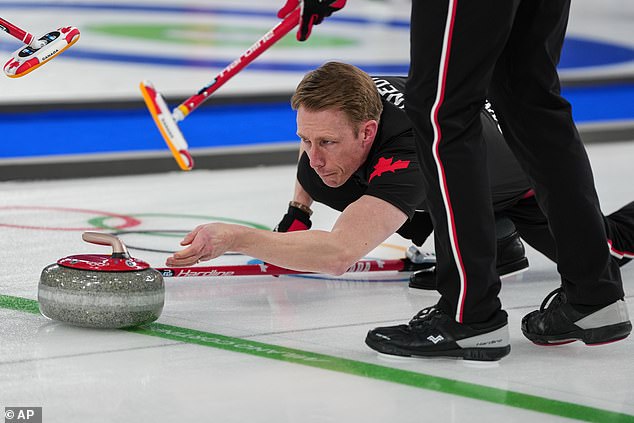
Eriksson pushed the issue hard. According to broadcast audio from Swedish TV and subsequent reporting, he insisted Kennedy was touching two meters over the hog line and promised to show video after the game. Kennedy snapped back across the sheet, “I haven’t done it once. You can f*** off.”
The game was paused after the second end as both teams took their complaints to the officials. Eriksson pressed a judge: had they seen the touching, and was it allowed? Meanwhile, Canadian lead Ben Hebert fired right back, asking officials to keep an eye on Eriksson’s deliveries, too.
Footage from the sixth end reportedly shows Kennedy releasing a stone, then extending a finger that appears to remain in light contact as it reaches the hog line, exactly the gray area Sweden was furious about.
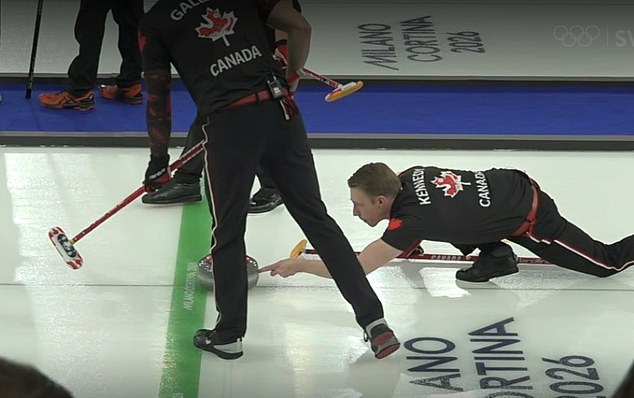
The Take
Curling sells itself as the sport where everyone apologizes, helps each other sweep, and then buys a round at the clubhouse. Friday night in Cortina looked more like a playoff baseball argument at second base.
Let’s separate the noise.
First: Kennedy’s outburst was raw and very human. You spend your life building a reputation as a clean, technical player; someone shouts “cheater” at you on the Olympic stage; the F-bomb is going to be waiting in the wings. It doesn’t make it admirable, but it does make it understandable.
Second: Sweden wasn’t inventing drama from thin air. The entire controversy lives in a technical detail: how long your hand stays on that stone. The World Curling rules are very clear on paper, but fuzzy in real time at full speed. If slow-mo replay shows fingers flirting with the hog line, a rival team has every right to ask questions.
Where it goes sideways is the vacuum left by officials.
Both teams complained. The game was stopped. And yet, from what’s been reported so far, there was no decisive, on-the-spot ruling that put the matter to bed. No use of technology that fans can see. Just: play on, keep it moving, hope it blows over.
That’s how you turn a rules issue into a character issue. Instead of “Did his finger break the rule?” the story becomes “Is he a cheater?”
In 2026, every sport is living in the replay era. Tennis has electronic line-calling. Gymnastics has a video review. Even figure skating quietly checks under-rotations frame by frame. Curling still relies heavily on trust and human eyesight at a distance, then acts surprised when trust collapses under Olympic pressure.
If you want curling to stay a gentleman’s game, you can’t keep grading it with Wild West officiating.
Whether Kennedy was fully in the right or not, this is the moment curling’s leaders are being told: get your technology and your enforcement in line, or get used to hearing “f*** off” on the mic.
Receipts
Confirmed:
- Canada defeated Sweden 8-6 in round-robin play at the Cortina Curling Olympic Stadium on Friday.
- Marc Kennedy and Oskar Eriksson exchanged heated words during the match, including Kennedy shouting, “You can f*** off,” as heard on the live broadcast from Swedish television.
- Both teams raised concerns with on-ice officials after the second end about alleged delivery violations at the hog line.
- Curling rules specify that a player must fully release the stone before it reaches the near edge of the hog line; any contact after that point is an infraction under World Curling regulations.
Unverified/Reported:
- Sweden’s claim that Kennedy repeatedly double-touched the stone well past the hog line remains an allegation; there has been no official public ruling labeling his actions as cheating.
- Eriksson reportedly told Kennedy he had video proof showing a stone being touched two meters over the hog line. That video has not yet been released publicly or independently authenticated.
- Any suggestion of intent (“Did he mean to cheat?”) is purely speculative; no governing body has issued a statement accusing Kennedy of deliberately breaking the rules.
Backstory (for the Casual Reader)
If you dropped out of curling after the Vancouver Games, here’s the refresher.
Brad Jacobs is a Canadian skip and former Olympic gold medalist, part of the country’s long tradition of curling dominance. Marc Kennedy, his third here, is another seasoned champion with multiple major titles. On the other side, Sweden’s Oskar Eriksson and teammate Niklas Edin have spent the last decade turning Sweden into curling’s cold-blooded efficiency machine, racking up world championships and Olympic medals.
These are not weekend leaguers. These are the heavyweights.
Curling itself is often called “chess on ice,” famous for its sportsmanship: players call their own fouls, concede when they’re beaten, and generally behave as if the postgame beer is more important than the medal. That’s why this kind of open, angry confrontation lands so hard. It’s not just about one finger on one stone; it’s about whether the sport can keep its nice identity once the Olympic pressure cooker is turned all the way up.
When emotions and reputations are on the line at the Olympics, do you want officials stepping in with tech and hard rulings, or should curling keep leaning on trust and player-to-player honor, even if it means more scenes like this?



















































































Comments