

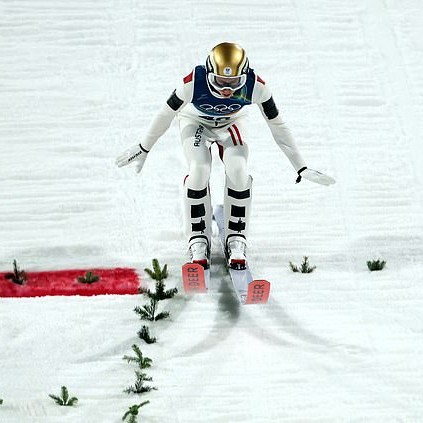
While the internet fixates on so-called “penis-gate,” one Olympic medal hopeful just lost his shot over four millimetres of extra boot.
The Moment
Austrian ski jumper Daniel Tschofenig, 23, was disqualified from the Winter Olympics individual final in Milan-Cortina after his boots were found to be four millimetres too big under equipment rules.
He had put down a strong first jump, scoring 137.7 points and sitting safely in the mix, when officials pulled him from the standings following a post-jump equipment check, according to the live broadcast on TNT Sports.
On Austrian broadcaster ORF, Tschofenig admitted the mistake was his, saying he had tried new shoes in training, was not thrilled with them, but kept them anyway and failed to recheck the exact size. He called the oversight incredibly stupid and said he had been naive about the rules.
The Take
We have officially reached the era of Olympic by tape measure: boots off by four millimetres, out. Crotch scanned in 3D, cleared. Human beings reduced to CAD drawings and leather tolerances.
In one sense, this is simple. Ski jumping is a sport of physics. Tiny changes in surface area or equipment can mean several extra metres of distance, and at this level, that is the difference between a medal ceremony and a quiet flight home in economy.
The rules are there for a reason. If you let one guy have looser boots, you are basically letting him tweak how his weight is distributed on the skis and how the whole system behaves in the air. That adds up.
But when an Olympic dream can be vaporised by 4mm of leather, while the governing body is scanning groins for alleged enhancements, you start to wonder who this sport is really serving.
Because hovering over Tschofenig’s heartbreak is the broader circus: unsubstantiated claims that some male jumpers have been injecting hyaluronic acid into their genitals to increase circumference, which in turn lets them wear slightly bigger suits for better aerodynamics. The International Ski and Snowboard Federation (FIS) responded with 3D body scans and tamper-proof suit microchips this season.
Scientific research backs the general concern. A study published in the Frontiers family of journals found that every two centimetres of extra suit circumference could cut drag by about four per cent and boost lift by around five per cent, translating to roughly 5.8 extra metres of flight. At the Olympic level, that is enormous.
So yes, hyper-precise rules are defensible. But the way they are enforced matters. Tschofenig is not accused of doping, cosmetic injections, or sneaky tailoring. He wore a pair of boots outside the limit, admitted the error, and paid the ultimate price in sport: disqualification from the biggest stage there is.
Meanwhile, the salacious “penis-gate” narrative grabs all the headlines, despite there being no public evidence that anyone has actually been sanctioned for those specific alleged procedures. It is a perfect example of how modern sports coverage loves the scandal, then forgets the athlete left standing in the cold with his gear in his hands.
The older you are, the more this feels familiar. We have seen swimsuits banned, high-tech running shoes questioned, and figure skaters graded to death by decimals. Increasingly, the story at the Olympics is not just who is the best athlete, but who survived the rulebook unchanged.
Receipts
Confirmed
- Disqualification over boot size: During the Milan-Cortina Winter Olympics ski jumping event, TNT Sports commentator Ian Findlay told viewers that Daniel Tschofenig had been disqualified after the first round because his boots were four millimetres over the allowed size.
- Tschofenig’s own admission: In an interview aired on Austrian broadcaster ORF, Tschofenig said he had used new shoes he did not love, failed to verify their measurements, and called himself naive and incredibly stupid for the oversight.
- Rule-tightening around suits and bodies: Officials have introduced 3D body scanning for ski jumpers and tamper-proof microchips in competition suits this season, measures the FIS has described as a way to prevent athletes from manipulating suit size and shape for extra lift.
- Aerodynamic effect of suit circumference: A study cited in sports science reporting from the Frontiers journal group found that a modest increase in suit circumference can significantly reduce drag and increase lift, adding several metres to a jump.
Unverified or Alleged
- Hyaluronic acid injections for advantage: There have been unsubstantiated claims circulating the Games that some male jumpers are injecting hyaluronic acid into their genitals to increase girth, which would allow them to qualify for slightly larger, more aerodynamic suits. No individual athlete has publicly confirmed this, and there have been no specific disciplinary cases named in relation to these allegations as of this writing.
Backstory (For the Casual Reader)
Ski jumping has quietly been one of the most rule-obsessed sports in the Winter Games. Because jump distance is so sensitive to body weight, clothing, and equipment, the FIS has spent years tightening controls on everything from suit fabric to where a zipper sits on the chest. At the 2022 Winter Olympics in Beijing, several top female jumpers were disqualified over suit violations that teams argued were within the rules in previous events, sparking outrage and confusion. Since then, the federation has leaned harder into technology, body scans, microchips, and more frequent equipment checks, all in the name of fairness. The upside is a more level playing field; the downside is moments like Daniel Tschofenig’s, where one of the best athletes in the world is tossed from an Olympic final not for a failed drug test or clear cheating scheme, but for four millimetres of boot.
What do you think: have the Olympics pushed equipment and body policing too far, or is this level of scrutiny simply the cost of true fairness at the top of sport?
Sources: Summarized from on-air comments by TNT Sports during the Milan-Cortina 2026 Winter Olympics ski jumping broadcast (Feb. 15, 2026); Daniel Tschofenig s interview with Austrian broadcaster ORF (reported Feb. 2026); public descriptions of FIS ski jumping equipment and suit regulations updated in recent seasons; and sports science findings reported from the Frontiers journal group on the aerodynamic impact of suit circumference.



















































































Comments