

The Moment
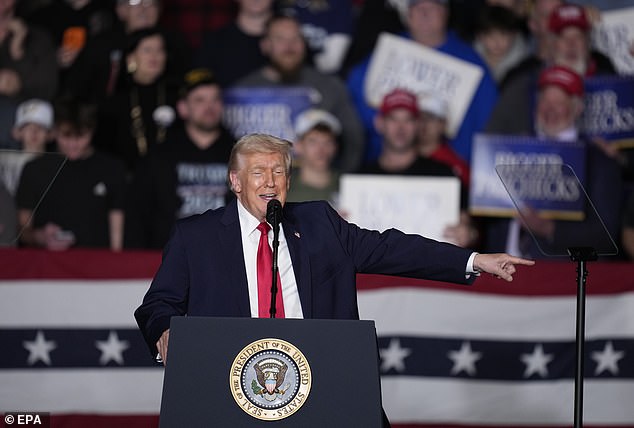
In Clive, Iowa, President Donald Trump used what was supposed to be a straightforward economic speech to do what he does best: turn chaos into a show.
Speaking to a largely friendly crowd about clean energy standards, ethanol, tariffs, and 401(k) savings, the 79-year-old president was interrupted about 30 minutes in by a loud protester. According to event coverage and photos from the venue, the outburst kicked off just as Trump was boasting about how he is standing up for American workers and farmers on trade.
Instead of ignoring the disruption, he leaned right into it. He quipped that he could have had a “nice, easy presidency” if he’d been willing to take a quieter path. Then he referenced his now-famous injury from the Butler, Pennsylvania rally shooting, joking that he’d “probably have this little piece of ear back” if he’d opted for the easy route.
As security moved on the protester, Trump complained he wouldn’t have to “listen to lunatics like this” in that alternate universe. The crowd responded on cue with chants of “USA! USA! USA!” while the demonstrator was pushed back and the commotion died down.
Scene outside Horizon Event Center in Clive, Iowa, where President Donald Trump will deliver a speech on energy and the economy. A couple hundred already gathered in freezing weather to protest his administration’s immigration policies and enforcement. pic.twitter.com/9Spy4mli4K
— Tom Barton (@tjbarton83) January 27, 2026
Minutes later, another protest broke out. This time, Trump escalated his language, claiming the disruptors were “paid” agitators and calling them “paid insurrectionists” and “sickos,” without offering any evidence of who supposedly signed the checks.
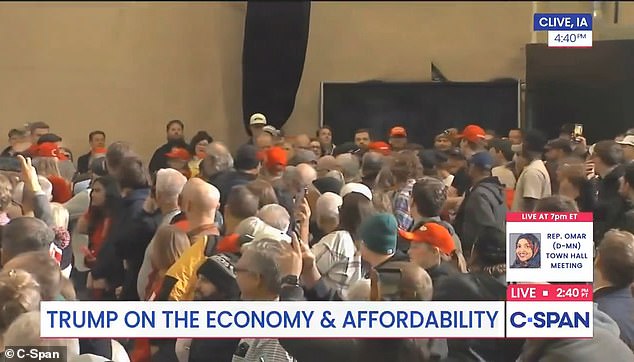
Each time, he snapped back to the telegraphed message of the night: the economy. He tore into “sleepy Joe” Biden, blamed the previous administration for a historic trade deficit, and insisted his team is rescuing the country from inflation. He also claimed the stock market has hit 52 all-time highs since he returned to office and that $9 trillion has been added to Americans’ retirement and 401(k) accounts – a number that, as even the event coverage noted, appears highly inflated compared with typical retirement growth estimates.
So the headline moment in Iowa wasn’t really the policy talk. It was Trump turning hecklers into props for his favorite storyline: he’s the embattled warrior-president who could have chosen comfort, but instead chose combat.
The Take
Iowa didn’t show us a “new” Trump. It showed us a Trump who is older, battle-scarred, and even more convinced that conflict is his oxygen.
On paper, this was an economic speech targeted at voters who are exhausted by prices and volatility. In practice, it was performance art about how hard his life supposedly is – complete with a callback to the terrifying moment in Butler when a bullet grazed his ear.
That “nice easy presidency” line is revealing. He’s selling himself as the man who sacrificed comfort for the country, yet he clearly enjoys the brawl. It’s like watching someone complain about the smoke while they keep tossing lit matches into the ashtray. The protesters give him what he craves: a foil, a villain, a chance to say what many in the crowd are thinking but won’t shout into a microphone.
The “paid insurrectionists” jab is where things get sticky. First, there’s no public evidence the protesters were on any payroll. Second, using the word “insurrectionists” is loaded, given how much that word has defined his own political baggage since January 6, 2021. Turning it around on critics is very on-brand for him – if a label hurts, he’ll try to slap it on someone else.
Substantively, this all happened against a backdrop that actually matters to people’s bank accounts. A recent national poll conducted in January found inflation and the overall economy are still the top concerns for American voters. Trump knows this, so he keeps pounding the idea that he’s turned things around since Biden – even as he leans on economic stats that sound more like applause lines than carefully sourced numbers.
The takeaway from Iowa isn’t just that Trump is still Trump. It’s that he’s betting voters will accept a certain level of exaggeration and drama as long as they feel their 401(k) statements are moving in the right direction. The question is how long that trade-off holds, especially for swing voters who are tired of feeling like extras in a never-ending rally.
Receipts
Confirmed:
- Trump spoke in Clive, Iowa, on January 27, 2026, at an event billed as remarks on the economy and energy policy, according to contemporaneous coverage and images from the venue.
- He was interrupted multiple times by protesters during the speech and referred to them as “lunatics,” “paid agitators,” “paid insurrectionists,” and “sickos,” based on direct quotes reported from the room.
- He joked that he could have had a “nice easy presidency” and referenced the piece of his ear that was injured during the July 13, 2024 rally shooting in Butler, Pennsylvania.
- The Butler incident involved gunfire that grazed Trump’s ear; law enforcement briefings and public reporting from 2024 confirmed that the shooter, identified as Thomas Matthew Crooks, was killed by security at the scene.
- A January 2026 national poll by a media company and its research partner found inflation and the economy were the top voter concerns, as summarized in the same event coverage.
Unverified or Contested:
- Trump’s claim that the Iowa protesters were “paid” and working as “paid insurrectionists” has not been backed up with public evidence.
- The assertion that $9 trillion has been added to Americans’ retirement and 401(k) accounts under his current term is treated even in friendly coverage as likely exaggerated relative to typical market and savings growth.
- His broader framing that Biden’s economy is now being decisively “fixed” by his administration is political spin rather than a neutral economic consensus.
Backstory (For Casual Readers)
For anyone who hasn’t followed every twist: Donald Trump, the 45th president, left office in January 2021 after losing to Joe Biden but never really left the political stage. He stayed the dominant figure in Republican politics, hinted at another run almost immediately, and ultimately made his way back to the White House, returning to power in his late seventies. Along the way, he built a long history of clashing with protesters at rallies, regularly ordering security to remove them and mocking them from the podium.
One of the most dramatic moments of his recent political life came in July 2024, when he was wounded in the ear by gunfire during a campaign rally in Butler, Pennsylvania. That near-assassination attempt has since become a central part of his personal mythology – proof, in his telling, that he’s literally taking bullets for the country. So when he jokes in Iowa about missing a piece of his ear, he’s mixing gallows humor with a reminder of just how high the stakes around him have been.
What’s Next
If Iowa is any hint, expect Trump’s 2026 midterm message to revolve around three pillars: the economy, grievance, and the idea that his critics are not just wrong but illegitimate. Calling protesters “paid insurrectionists” is a preview of that third theme, and it raises a real question about where the line is between harsh politics and simply discouraging dissent.
In the near term, watch for a few things. First, whether the White House or Trump’s political team offers any proof to support the idea that the protesters were being paid. Second, how independent fact-checkers handle his big-dollar claims about retirement accounts and record stock market highs. And third, whether his opponents seize on the “nice easy presidency” line as a way to paint him as more interested in drama than governing.
Security-wise, the Iowa disruptions also underline an uncomfortable reality: after the Butler shooting, every public Trump appearance is a bigger production, with higher tension baked in. More protests are likely as the midterms get closer, and every clash will be another test of whether voters are still entertained, exhausted, or a little bit of both.
Sources: Event coverage and photos from Trump’s January 27, 2026 speech in Clive, Iowa; public reporting and law-enforcement briefings following the July 13, 2024 rally shooting in Butler, Pennsylvania.
Your turn: When you see moments like this – a president sparring with protesters mid-speech – do you think it helps him, hurts him, or just gives him exactly the spotlight he’s chasing?




























Comments