

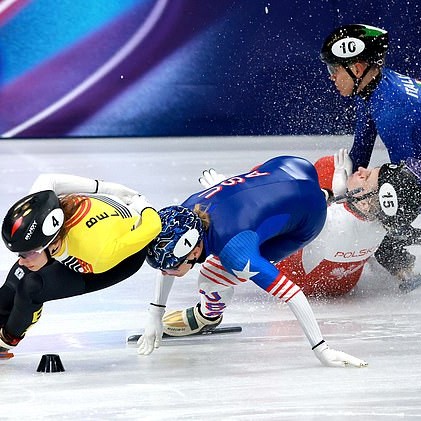
The Moment
One second, the women’s 1500m short-track at the Milan Cortina Winter Olympics was its usual chaos-on-ice. The next, it looked like a scene nobody signed up to watch.
Polish short-track speed skater Kamila Sellier went down hard on Friday night at the Milano Ice Skating Arena after a multi-skater tangle with Italian legend Ariana Fontana, a 15-time Olympic medalist, and American skater Kristen Santos-Griswold.
In the split-second pileup, a rival’s blade sliced Sellier just above her left eye. According to officials on site, she was quickly surrounded by medics as workers held up a large white sheet to block the view from a packed arena. Fans who showed up for the final night of short-track suddenly found themselves watching in stunned silence.
Short-track speed skater Kamila Sellier suffered a horrifying injury after a competitor’s blade sliced her above her left eye during the women’s 1500m at the Winter Olympics.
Read the full story 👇https://t.co/AsGsMVXbRY#MilanoCortina2026 pic.twitter.com/1KLyuhApG6
— Telegraph Sport (@TelegraphSport) February 21, 2026
Sellier was wheeled out on a stretcher, but not before giving the crowd a thumbs-up, even as there was visible blood in the final corner of the track that staff had to clean during the race pause.
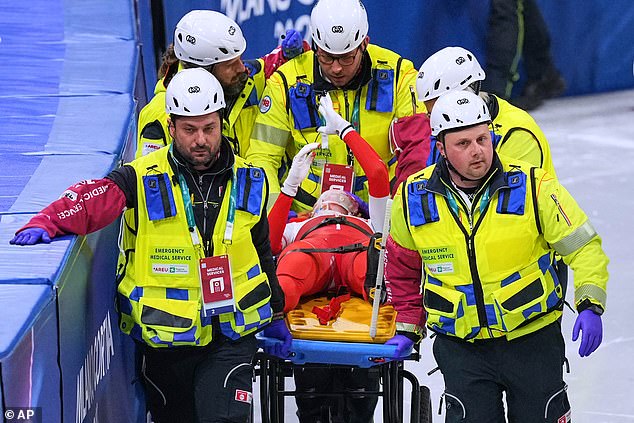
Polish Olympic officials later confirmed that her eye itself appears to be okay, crediting the sport’s mandatory goggles for preventing a much worse outcome. She needed stitches at the arena and then underwent surgery in the hospital when scans revealed a fractured bone around the injured area, according to the Polish Olympic Committee president.
He added that Sellier woke with “significant swelling” and will undergo eye movement tests, but that her eye passed its first round of checks – the small miracle in a very scary moment.
On the competitive side, Santos-Griswold was penalized for an illegal lane pass that contributed to the crash, which stopped her from advancing beyond the quarterfinal. Fontana, whose skinsuit was nicked and hip treated during the delay, got back on the ice, finished second in her heat, and then went on to make the final, continuing her chase of the all-time Winter Olympic medal record.
The Take
I know the Olympics have always flirted with danger – skiing off cliffs, hurling yourself headfirst on a sled, all of it. But short-track speed skating is starting to feel like NASCAR on razor blades.
We tune in for the suspense and the photo finishes, not to watch a young athlete disappear behind a curtain and reemerge in a surgery report. That viral clip (yes, the one with the graphic warning slapped on top) is a brutal reminder of what’s really happening out there: people racing inches apart at highway speeds, on blades sharp enough to carve your Sunday roast.
What struck me is how the hero of the night wasn’t a coach, or a legendary champion, but something totally unglamorous: protective goggles. Those dorky little lenses just saved a woman’s eyesight. In a world where we obsess over skinsuit fabrics and aerodynamic hoods, maybe we should be talking more about the gear that keeps faces intact.
And let’s be honest: for a lot of viewers – especially those of us 40 and up watching from the couch – the line between “thrilling” and “too much” is getting thinner every Olympics. We’ll accept bruises and wipeouts. We do not need spurting blood on Olympic ice to prove these athletes are tough.
Short-track has always sold itself as the wild child of the rink: elbows out, strategy meets chaos, anything can happen. But when “anything” includes a blade inches from an eyeball, it’s fair to ask where the sport goes from here. Do we rethink passing rules? Track size? More face protection? Or do we just keep crossing our fingers and hoping the goggles keep doing overtime?
This crash felt less like an “unlucky moment” and more like the bill coming due on a sport that’s been flirting with disaster for years.
Receipts
Confirmed:
- Kamila Sellier was involved in a crash during the women’s 1500m short-track race at the Milan Cortina Olympics and was cut above her left eye by another skater’s blade.
- Medics treated her on the ice behind a white sheet before she was taken out on a stretcher; she gave a thumbs-up to the crowd.
- Polish Olympic officials confirmed she received stitches, suffered a fractured bone, and underwent surgery to repair the damage.
- Officials say her eye itself passed initial medical tests, with further eye movement tests planned.
- All short-track skaters wear protective goggles, which officials credited with preventing more serious eye damage.
- Kristen Santos-Griswold was penalized for an illegal lane pass that contributed to the collision and did not advance.
- Ariana Fontana’s skinsuit was damaged; she received treatment on her left hip, finished second in her race, advanced to the semifinal, and then the final.
- Fontana entered these Games as one of the most decorated Winter Olympians, and earlier in Milan Cortina won gold in the 2000m mixed relay and silver in the 500m and 3000m relay.
Unverified / Open Questions:
- Any long-term impact on Sellier’s vision or competitive career has not been determined; doctors are still evaluating.
- Whether this incident will directly trigger new safety rules or equipment standards in short-track has not yet been announced.
Backstory (For Casual Readers)
If you only dip into the Winter Olympics every four years, here’s the quick download. Short-track speed skating is the tight, frantic version of regular speed skating: smaller oval, more skaters, more passing, more chaos. Think of it as the difference between a quiet highway and a downtown roundabout during rush hour.
The athletes race on long, exposed blades that can be dangerously sharp. Crashes are common even when nobody does anything “wrong”; add split-second lane changes and desperate passes, and suddenly you’ve got ten people hurtling around the corner with nowhere to go.
Italian skater Ariana Fontana is the sport’s queen bee – already one of the most decorated Winter Olympians in history, chasing Norwegian cross-country legend Marit Bjrgen’s record medal total, according to Olympic records. At Milan Cortina, Fontana has already added gold in the 2000m mixed relay and silvers in the 500m and 3000m relay to her trophy case.
Kamila Sellier, meanwhile, is part of a newer wave of talent representing Poland in short-track. While she’s nowhere near Fontana’s fame level (few are), this kind of terrifying incident, unfortunately, tends to be how casual viewers learn a lesser-known athlete’s name.
Standard safety gear includes cut-resistant suits, gloves, helmets, and goggles. Face cages or full shields, though, are not the norm in short-track the way they are in some other high-risk sports.
What’s Next
For Sellier, the immediate future is all about medicine, not medals. Doctors will be watching the swelling, checking her eye movement, and making sure the repaired bone heals cleanly. There’s no public timeline yet for when – or if – she could return to full-intensity racing this season.
Expect a wave of public support from fans and fellow skaters; this sport functions like a small, intense family. A clip this shocking almost always sparks a round of “we need to talk” among athletes, coaches, and governing bodies about how far they’re willing to push risk for the sake of a more dramatic broadcast.
Short-track’s leaders now have an opening, and honestly an obligation, to revisit safety: Are goggles enough? Should there be stronger face protection? Tighter rules on passing in certain corners? Nobody wants to turn the sport into bumper cars, but someone just took a blade to the face on live TV. That’s not a footnote.
For the rest of us, the takeaway is simple: the next time you see an Olympian suited up from head to toe, remember that the least glamorous piece of equipment might be the one keeping your favorite event from turning into a horror show.
Do you think short-track needs stronger face protection after this, or is danger simply part of what keeps fans glued to the ice?
Sources: Live Winter Olympics broadcast from Milan Cortina (20 Feb 2026); on-record comments from Polish Olympic Committee officials reported via Eurosport (20-21 Feb 2026); historical Olympic medal data from official Olympic records (accessed pre-2024).



































































Comments